A book. Bear and Rabbit.

I wish I can be Bear, without the Rabbit’s mentality.
On another note, I would also like to own this book.
2024 Primary School Teacher Education Program (PISMP), Malaysia
The Ministry of Education will be recruiting new students for the 2024 Primary School Teacher Education Program (PISMP) from March 14th to April 15th, including the UEC Teacher Training Program. The National Union of Teachers urges eligible and aspiring secondary school students who wish to become Chinese primary school teachers to seize the opportunity and enthusiastically apply for the courses offered by Chinese primary schools. The application website is https://pismp.moe.gov.my/.
Candidates who have just completed the 2023 SPM can apply for the PISMP course. After the release of the SPM results, the Ministry of Education will reopen the website for everyone to update their course options.
Courses offered for Chinese primary schools:
- Malay Language
- Malay Language (Additional Remedial Course Guidance – Pemulihan)
- Chinese Language (Additional Physical Education)
- English (TESL – Teaching English as a Second Language)
- Music
- Art
- Mathematics
- Science
- History
- Early Childhood Education
- Design and Craft
- Counseling
- Special Education (Learning Disabilities, Hearing Impairments)
- Physical Education (Additional Moral Education)
- Physical Education (Additional Health Education)
- UEC Teacher Training Program – Chinese Primary School Chinese Language
Watch Movie with Your Students/Children.
Today, I received this in my inbox and I just could not believe that this type of resource exists at no cost at all.
Common Sense provides Movie Guidance and Lesson Plan for primary and secondary school teachers to help students reflect on their Social and Emotional aspects. The guide includes: Lesson Objectives, Particular Clips + SEL Questions, printable Lesson Plan and Graphic Organiser (what to do before, during and after movie + more activities for students to do)
I think this is a great resource to implement during February School Holidays (Malaysia). Large screen, healthy snack and a pool of kids to talk about the movie, Encanto, is a great start. Don’t you think?

*I think the movie is on Netflix. Anyway, I can watch this for free 😊
Montessori Practical Life – Deep Dan Ghee Stick (Ghee Lamp Thulasi Stick)
“The environment must be rich in motives which lend interest to activity and invite the child to conduct his own experiences.” – Maria Montessori, The Absorbent Mind book.
I am delighted to share another exercise of Practical Life which is deeply rooted in the ancient Vedic tradition. Vedic tradition which is linked to the current nation called India, previously Bharata-Varsa, transcends time, places and science. Children who practise the Vedic eternal spiritual routine are able to see their parents or grandparents offering light, in the form of a lamp, to the object of worship in their home. Many homes also use dried Thulasi twigs, cotton and ghee/oil as an offering because Thulasi plant is considered sacred and worshipable.
This exercise provides a great opportunity for children to get to know the plants in their environment and how else can the plants be used even after their life span is over.
Some children may celebrate their identity and culture through this work, while others gain more awareness of other people’s cultures and cultivate a sense of respect for the diversity of human experience.
Placing this activity at the Practical Life area will definitely capture a child’s curiosity, and lead him/her to strengthen and fine-tune his small hand muscles, finger dexterity and even pincer grip.
Hopefully holding the twigs carefully will instill a sense of gentleness in his movement and eventually, character!
*Vedic= Sanskrit word, related to the ancient holy scriptures.
*Thulasi = a name of a plant.
—>I am a Montessori educator who teaches basic Mandarin, occasionally a Malay and Mathematics teacher. I am looking forward to write the first page of book of my life in 2024. <—
Movie Time – For Teachers
Maybe now is the right time to watch this movie.
Some teachers are having their holidays now. Some would be in a few more days.
Most teachers would need to regain the momentum to teach, and the best time (or the only time) to recharge is during the school holidays.
One way to regain strength and faith that our students will somehow have a breakthrough is by watching a movie, like ‘To Sir, With Love’. If you feel like there is no hope in the teaching world, grab a chair and sit in front of the screen. There is always hope, and the academic world is not the only hope!
Movement, Rhyme and Holy Month.
Last week, we celebrated the end of Purushottama month with a feast-blast. During this period, I received in my email box, a joyful way of connecting with friends (young or old) using hand movements and singing a simple rhyme.
First, learn how to clap hands in a Tic-Tac-Toe way, as shown in the video below. You can also learn the simple rhyme in the clip.
“Tic Tac Toe, Give me an X, Give me an O, Give me three in a row”
Next, learn the Tic-Tac-Toe Rhyme by BhaktiKids and find a friend to play this game.
I wonder who would be my first partner.
#Tic-Tac-Toe
#Handmovement
#Rhyme
#Purushottama Month
Auspicious Purusottama Month Challenge – For Children (and children at heart)

This challenge comes every 3 years only! Grab it NOW!
CLICK  https://forms.gle/agy8ya62VhcxA1us6
Dates: 18th July – 16th August
 Collect 1000x benefit in your bhakti bank account
Receive a certificate signed by HH Jayapataka Swami
Receive a weekly calendar that contains cool Krishna conscious activities to do
Have your name offered to Radha Madhava, Panca-tattva and Nrsimhadeva in Mayapur
Get a free activity book
Join our online sangas 2x a week with other kids
And guess what?  “If you follow this Purusottama month sincerely, then you can go back to Godhead!”
#PurusottamaChallenge #bhaktikids#kids#krishna#harekrishna#radhakrishna#bhakti#yoga#fun#learning#spiritual#challenge#activity
Tutoring.
Tutoring is one of the most effective way for students to improve attainment in their studies. The most popular subjects to be tutored seem to be Mathematics and Science, however Language subjects are also gaining popularity among the tutoring realm.
The role of the tutor is to address gaps which are problematic with the students. So, it is not a matter of whether the subject is difficult but the students have not yet mastered certain skills required to advance further in the topic.
The nature of the topics in any subject is cumulative, that is to say that the concepts in any subjects build on one another. A child will struggle and fall behind if he/she does not have a solid understanding of essential concepts.
To become an efficient and successful tutor, it is important to establish what you want to achieve first, before accepting a student. These are a few preliminary steps to help you kickstart:
- Target amount of students you can teach in a month.
- Target amount of tuition fee you would like to earn (Individual tuition fee will be higher than group fee as the attention given is more. Also consider preparation time that is required for certain focus group, which will require higher fee too.)
- Increase students’ confidence in the subject.
- Improve understanding and answering exam techniques.
- Improve major exam attainment percentage.
Scheduling, planning and responding to parents’ queries can consume most part of a tutor’s day. An innovative educational programme will certainly play a great role in supporting your tutoring journey.
Introducing VSchool Trend Learning Program:
VSchool Trend Learning Program is a comprehensive online learning platform designed to help students of any age groups to excel academically. It offers a wide range of interactive notes and practice materials aligned with the Malaysian education curriculum.
Experience the benefits of VSchool Trend Learning Program for yourself by signing up for a free trial. Empower your student’s education with engaging content and progress tracking tools.
Sign up for a free trial of VSchool Trend Learning Program today and unlock your student’s academic potential!
Help me to draw a heart.
An emotion is a powerful energy in motion.
An emotion must flow for its full powerful energy to take effect. Blocking it can only cause harm. So, sometimes interrupted energy must be channeled to something more useful.
When a child who I thought was at an apt age to draw a heart shape unable to draw it and started to feel less confident about her ability, I guess it’s best to begin from what she is able to do first. And to think of how to do this within seconds, in front of the screen, during an online class, is a teaching method of differentiation in a teacher’s lesson plan.
THINK FAST AND ACT QUICK!
So, how can we teach a person how to draw a heart?
I can think of two ways.
Can you think of more ways?
Revisiting Denomination of Money
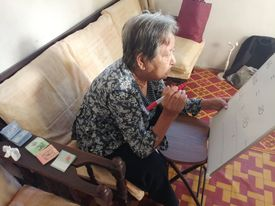
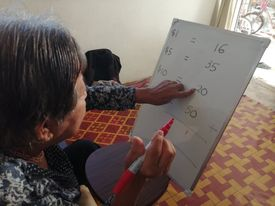
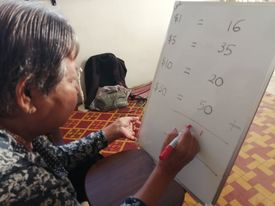
Lesson Plan: Revise the concept of denomination of money
Objective: Able to count a set of notes and find the total amount
Prerequisite: able to see the colour, numeral and amount of notes. able to separate the notes independently with unsteady fingers. able to retain the numbers in the memory and do arithmetic operation.
Age: 77+
Procedure:
Picture 1: Classify the notes according to their denomination group.
Picture 2: Multiply the number of notes with the denomination number.
Picture 3: Total up to get the total amount money
Extension: Think about what food can be bought using the sum of money. (We were about to leave home to get brunch and mum loves eating outside. She chose to have mixed rice with the total hundreds in her hand. hahah…)
Give a love if you have reached the end of this post 💕

-

Montessori Centenary 2007
Vote for me

Recent visitors
Meg Trezise on A nice image. rani on A Summer Bael story. Manohari Ramakrishna on A Summer Bael story. rani on Montessori Article (Free to… rani on CONVERSATION WITH MONTESSORIAN… -


 Montessori World